Posts

Showing posts with the label PAK1

Targeting Dendritic Spines to Improve Cognitive Function and Behavior in Autism; plus Hair Loss/Graying

Image
I have written several posts about dendritic spines and their varying shapes (morphology).   This sounds like a rather obscure subject, but it looks like it may be a key area where both behavior and cognition can be modified, even later in life. Homer Simson after using a Wnt Activator   Dendritic spines In a typical neuron (brain cell) you have dendrites at one end and so-called axon terminals at the other. When neurons connect with each other, an axon terminal connects with a dendritic spine from another close by neuron.   Axons transmit electrochemical signals from one neuron to the dendrites of other neurons.   The junction formed between a dendritic spine and an axon terminal is called a synapse. One neuron can have as many as 15,000 spines, some of which are picking up signals from axon terminals of other neurons. The number and shape of these spines is constantly changing and not surprisingly defects in this process affect both cognition and behavior. The othe...
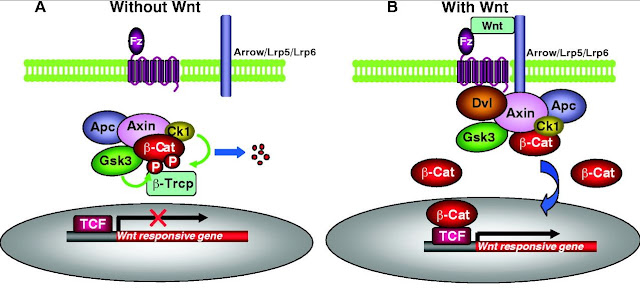
Modulating Wnt Signaling in Autism and Cancer

Image
Source: LDL receptor-related proteins 5 and 6 in Wnt/β-catenin signaling: Arrows point the way In earlier posts I have covered various signaling pathways such as Wnt, mTOR and the unusually sounding Hedgehog. You can go into huge detail if you want to understand these pathways, or just take a more superficial view. In most cases, things only start to go wrong if you are hypo/hyper (too little/too much) in these pathways. We saw with mTOR that most people with autism are likely to have too much activity and so might benefit from mTOR inhibition, but a minority will have the opposite status and stand to benefit from more mTOR activity. When it comes to Wnt signaling the research suggests the same situation. Wnt signaling is likely to be aberrant, but both extremes exist. Wnt signaling networks in autism spectrum disorder and intellectual disability Given the large volume of genetic data, analyzing each gene on its own is not a feasible approach and will take years to complete, let alone ...

PAK inhibitors and potentially treating some Autism using Grandpa’s Medicine Cabinet

Image
I wrote several posts about why PAK1 inhibitors should be beneficial in some autism and indeed some schizophrenia. We also saw that PAK1-blocking drugs could be potentially useful for the treatment of neurofibromatosis type 2, in addition to RAS-induced cancers and neurofibromatosis type 1. One problem with drugs developed for cancer is that, even if they finally get approved, they tend to be ultra-expensive.  Production volumes are low because even if they “work” they do not prolong life for so long and cancer has numerous sub-types. Cheap drugs are ones used to treat common chronic conditions like high blood pressure, high cholesterol and indeed treatment of male lower urinary tract symptoms (LUTS), like benign prostatic hyperplasia (BPH). A small number of readers of this blog have confirmed the beneficial effect of PAK inhibitors in their specific sub-types of autism.  The problem is that there are no potent PAK1 inhibitors suitable for long term use that are readily avail...